A log of every run. Each attempt keeps its request, response body, status code and latency, retries included.
How runs are recorded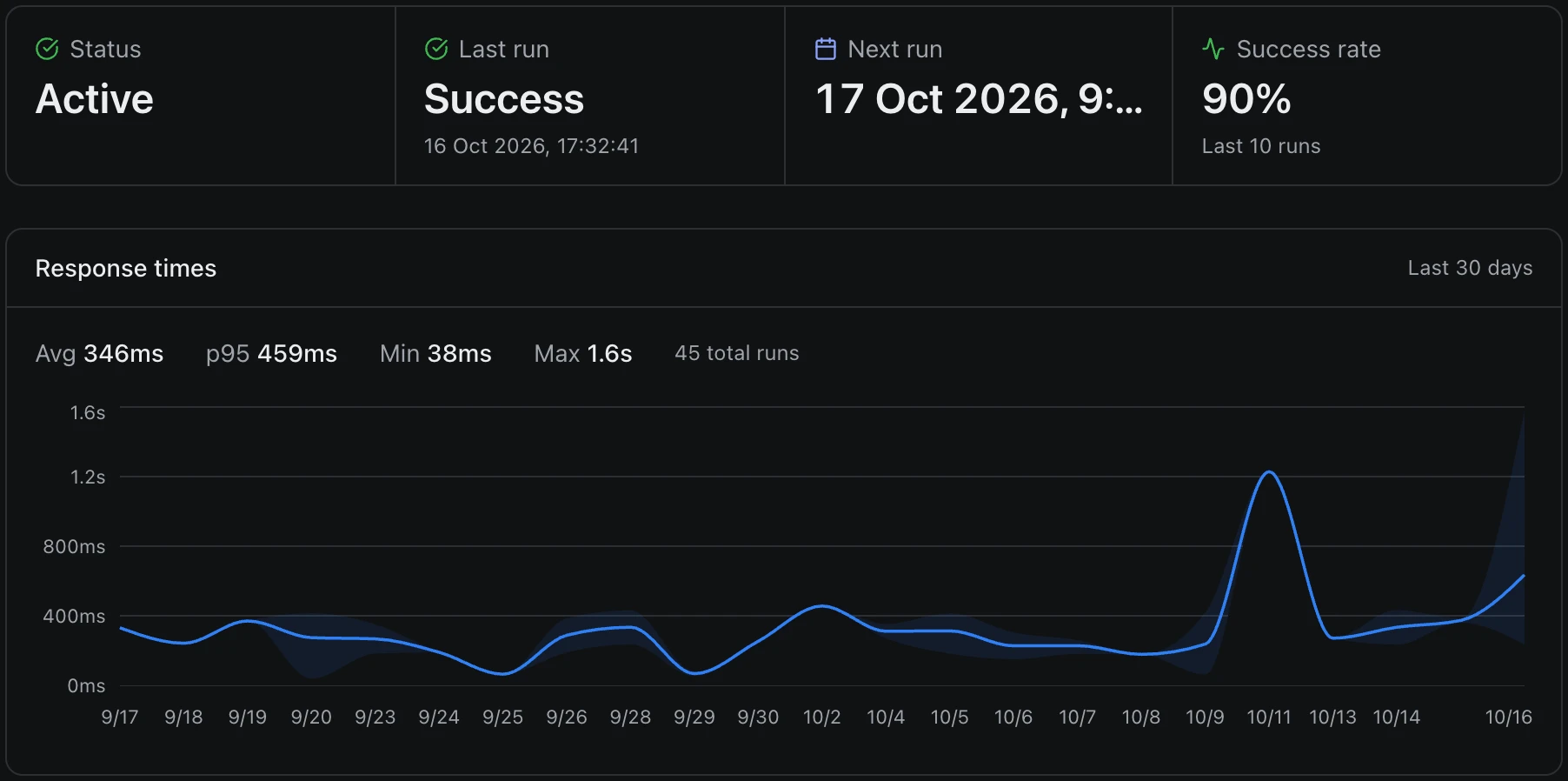
Run scheduled tasks over HTTP. Delay calls your URL on a cron schedule, after a delay or right away. It logs every response, retries failed jobs and alerts you when something keeps failing.
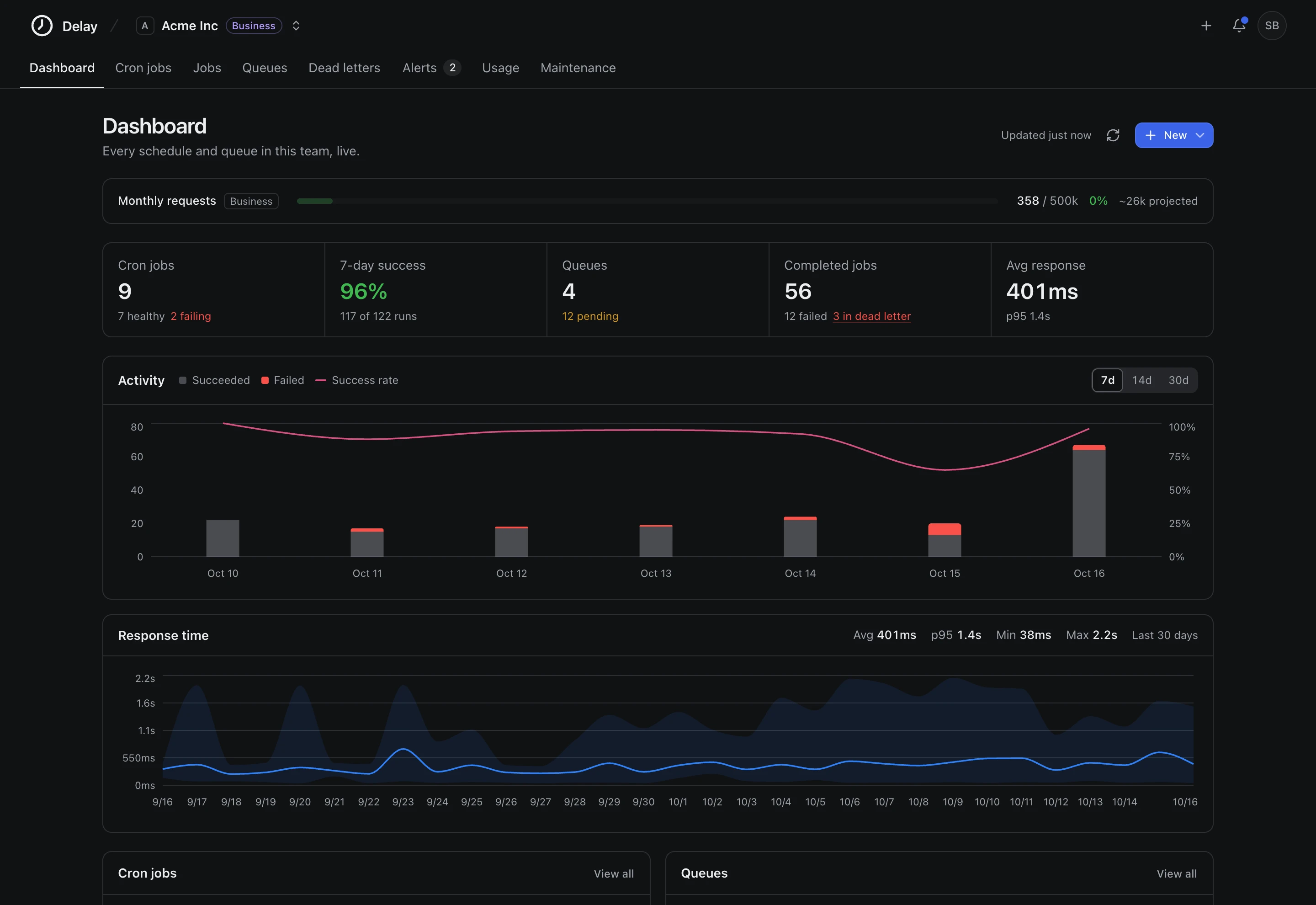
Send a URL, a queue and an optional delay or cron expression. Your app only needs an HTTP endpoint, so there is no SDK to add.
1# Send a POST request right now
2curl -X POST https://app.delay.run/api/jobs \
3  -H "Authorization: Bearer $TOKEN" \
4  -H "Content-Type: application/json" \
5  -d '{
6    "queue": "emails",
7    "url": "https://api.yourapp.com/send",
8    "payload": { "to": "[email protected]" }
9 }'1# Run a health check every 5 minutes
2curl -X POST https://app.delay.run/api/crons \
3 -H "Authorization: Bearer $TOKEN" \
4 -H "Content-Type: application/json" \
5 -d '{
6 "name": "Health Check",
7 "url": "https://api.yourapp.com/health",
8 "cron_expression": "*/5 * * * *",
9 "method": "GET"
10 }'1# Send a review request in 24 hours (the longest delay)
2curl -X POST https://app.delay.run/api/jobs \
3 -H "Authorization: Bearer $TOKEN" \
4 -H "Content-Type: application/json" \
5 -d '{
6 "queue": "reviews",
7 "url": "https://api.yourapp.com/review",
8 "delay": 86400,
9 "payload": { "order": "ORD-2847" }
10 }'1# Charge, then call us back with the result
2curl -X POST https://app.delay.run/api/jobs \
3 -H "Authorization: Bearer $TOKEN" \
4 -H "Content-Type: application/json" \
5 -d '{
6 "queue": "payments",
7 "url": "https://api.yourapp.com/charge",
8 "payload": { "amount": 2999 },
9 "callback_url": "https://yourapp.com/hook"
10 }'One-off and delayed jobs go to /api/jobs. Recurring schedules go to /api/crons.
Every run is saved with its request, response and timing. Failed jobs are retried, and you get an alert when something keeps failing.
A log of every run. Each attempt keeps its request, response body, status code and latency, retries included.
How runs are recorded
Retries with backoff. A failed job is retried on the schedule you set for its queue: after 1 minute, 30 minutes and 3 hours by default.
Retry strategy
A dead letter queue for failed jobs. When retries run out, the job moves to the dead letter queue with its full request and response. Fix the problem, then replay it.
The dead letter queue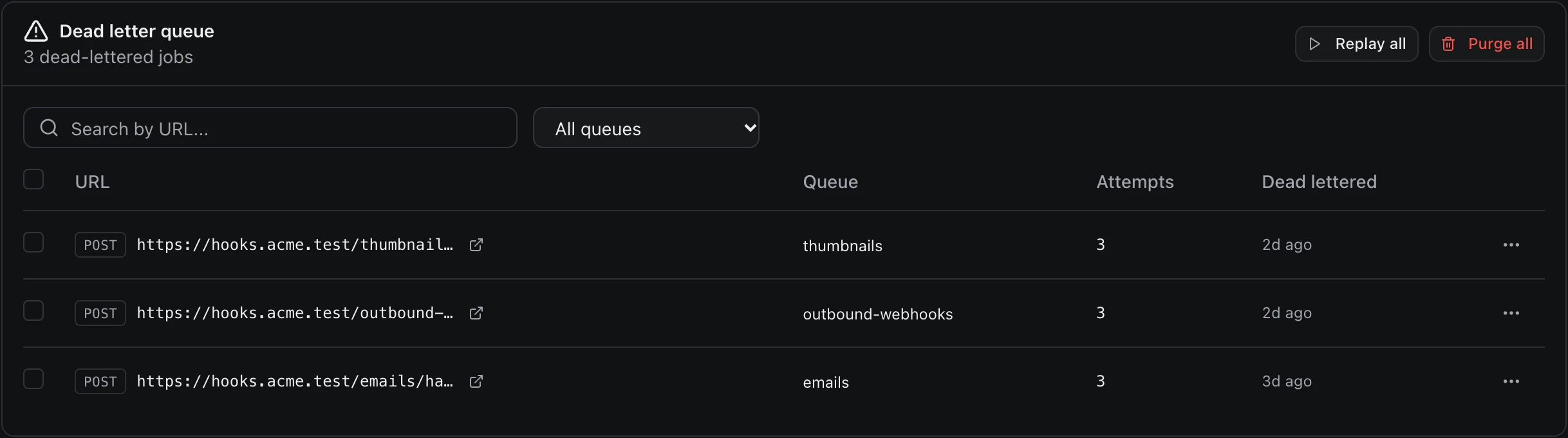
Every minute
is the shortest interval, using standard five-field cron syntax
2 years
of run history on Enterprise, with each request and response
Choose how many failures in a row should trigger an alert. Delay sends it to the channel you pick, and tells you again when the job recovers.
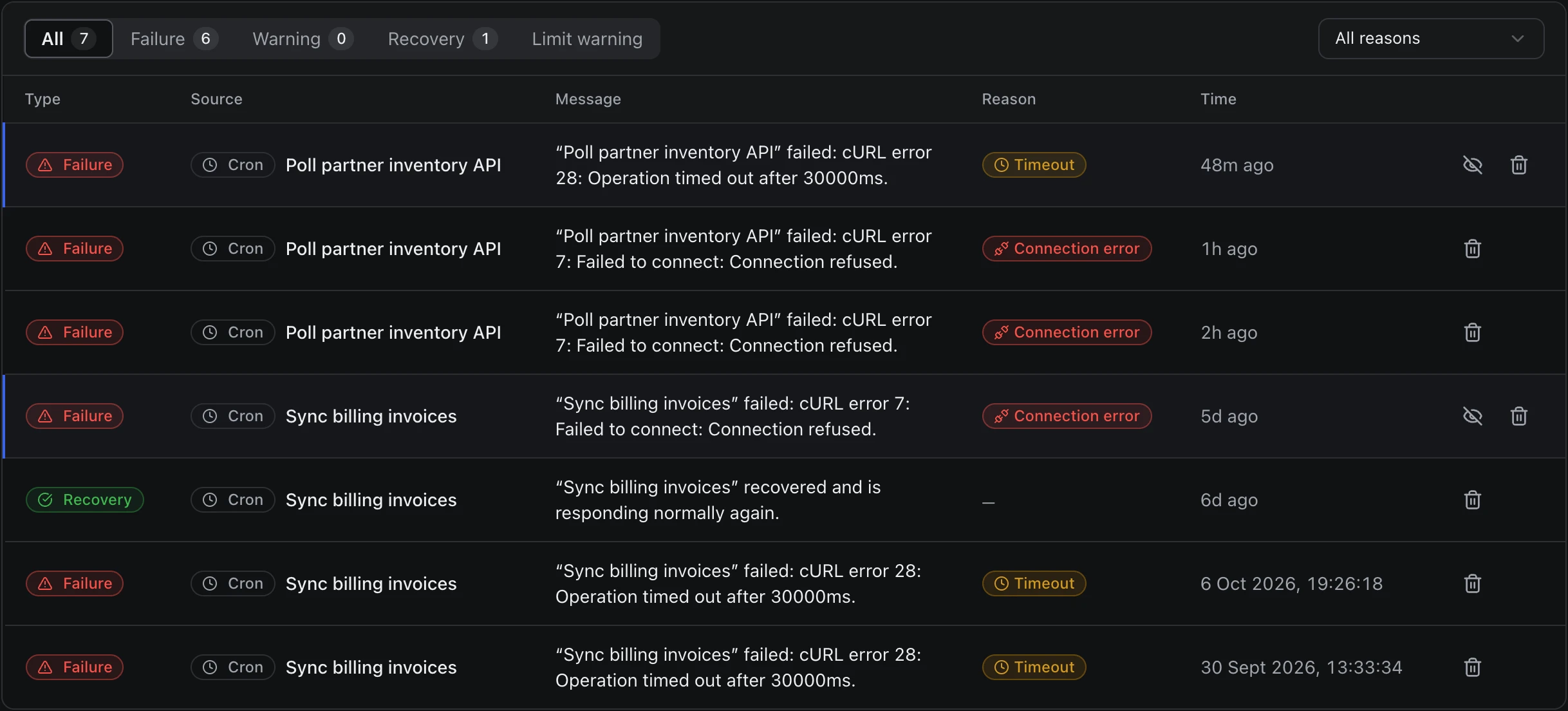
Poll partner inventory API failed 3 consecutive runs
Connection refused View run
Poll partner inventory API recovered
200 OK after 2 retries, down 41 minutes
The things you would otherwise have to build around crontab yourself.
Check more than the status code. Check the status code, a JSON path, the body or the response time. A failed check counts as a failed run, so it triggers retries and alerts like any other failure.
Success assertions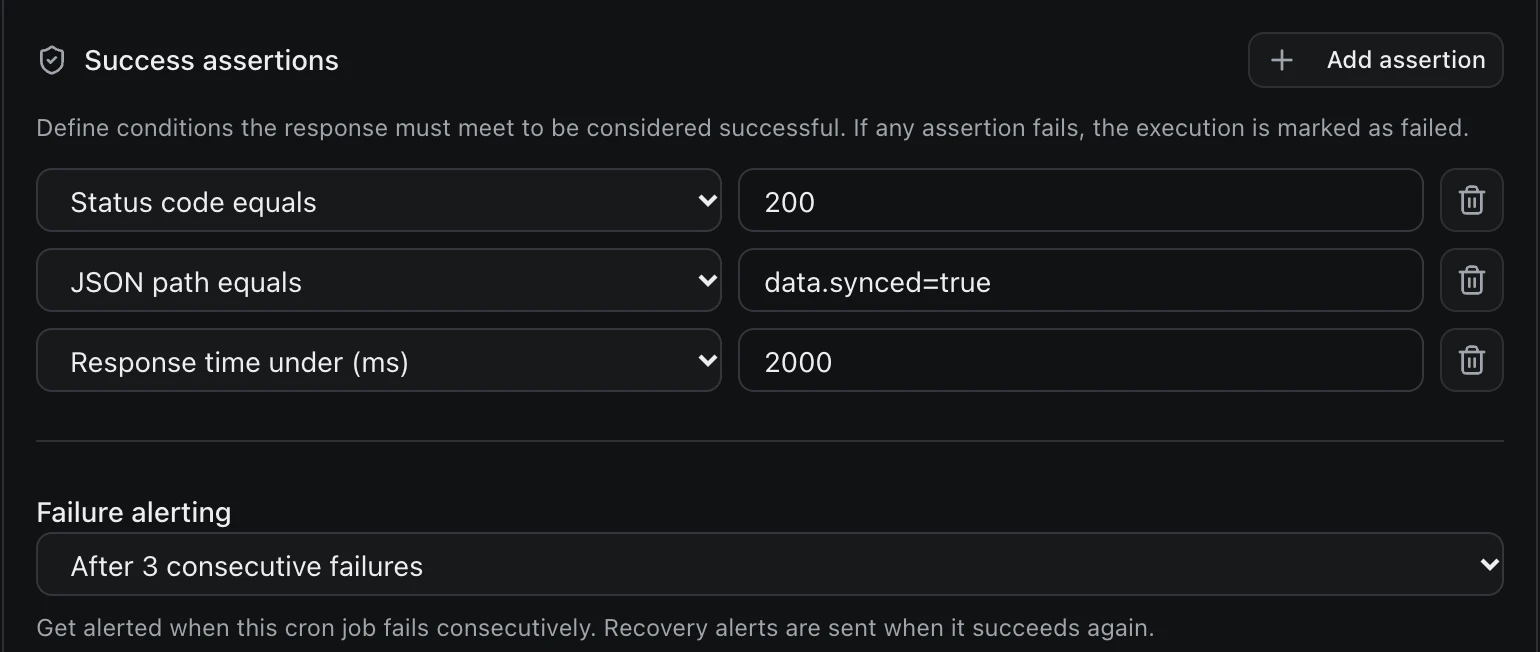
Maintenance windows. Mute alerts for one job or the whole team while you deploy. They turn back on when the window ends.
Maintenance windows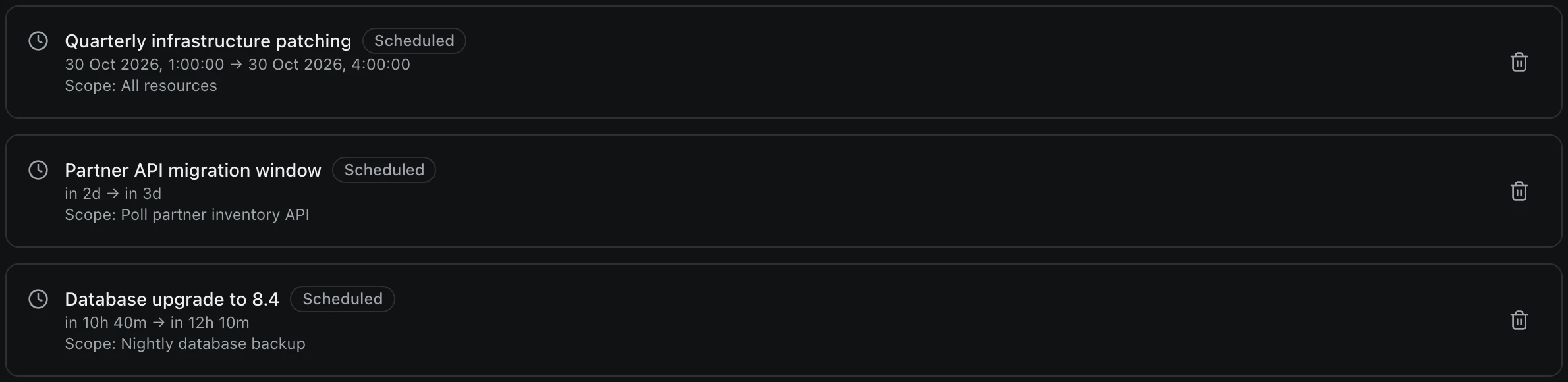
Signed requests. Every request carries an HMAC-SHA256 signature and a timestamp, so your endpoint can check that it came from Delay.
Webhook signing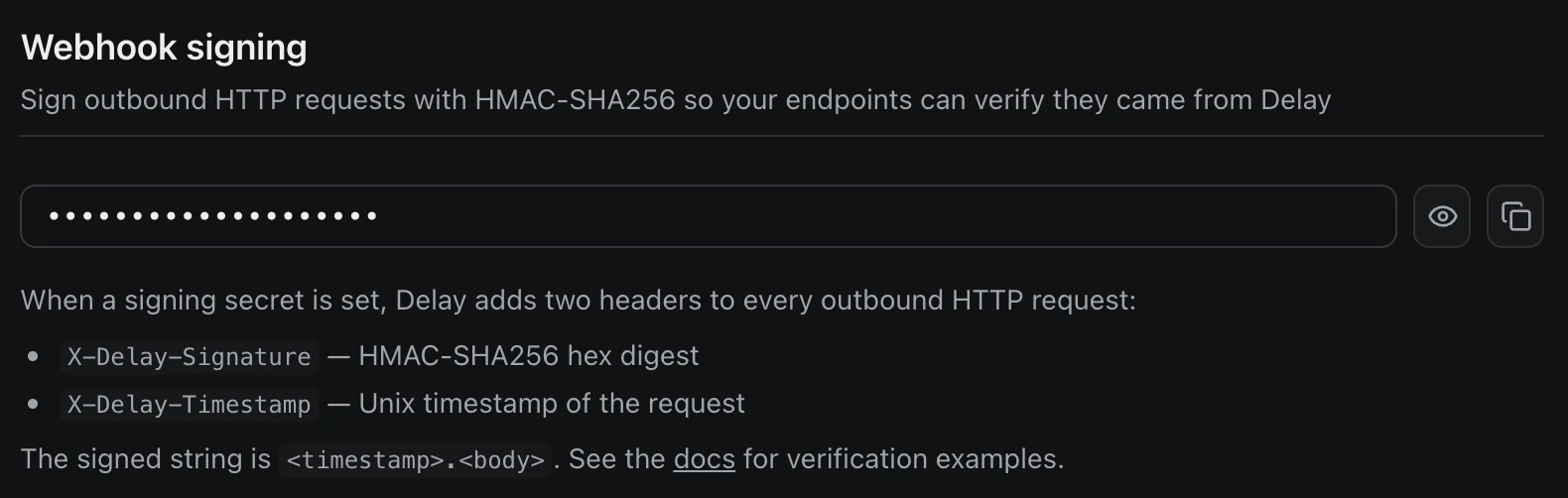
Monthly usage. Cron runs and job runs count toward one monthly total. The chart shows each day and a projection to the end of the month.
Compare plans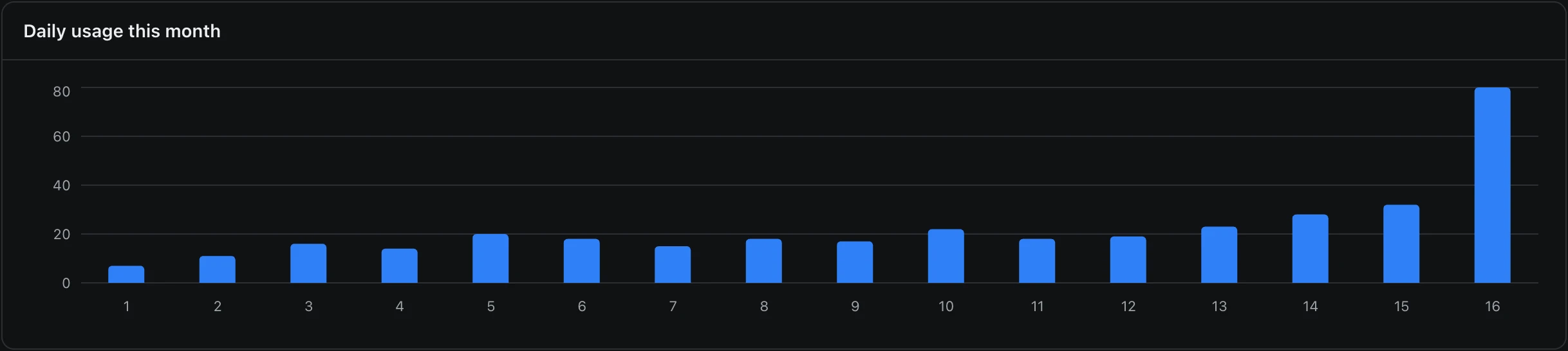
Plain HTTP
Delay sends normal HTTP requests, so it works with any language or framework.
0 3 * * *
POST /backups/nightly
Nightly backups & cleanup. Backups at 3am, session purges and log rotation, each with a run log to show it happened.
0 5 * * 1-5
POST /reports/sales-digest
Digests & reports. Send the 5am sales digest even when nobody has the app open.
* * * * *
GET /healthz
Health checks. Check endpoints every minute and get an alert on the first 5xx.
30 1 * * *
POST /sync/upstream
Data syncs & ETL. Pull data from other APIs every night. Retries handle flaky APIs, and response checks catch empty results.
0 9 * * *
POST /billing/dunning
Billing & dunning. Retry failed payments and send trial-expiry reminders on time, with an alert if they stop going out.
*/15 * * * *
GET /poll/shopify-orders
Poll APIs without webhooks. When a service has no webhooks, poll it on a schedule. Notion, Airtable and Shopify are common ones.
Cron monitors like Cronitor watch jobs you still run yourself. Basic cron services like cron-job.org call a URL with few retries or logs. Workflow tools like Inngest need an SDK in your code.
| What you get | Delay Runs, retries and alerts | Cron monitors Cronitor, Healthchecks | Basic schedulers cron-job.org, EasyCron | Workflow SDKs Inngest, Trigger.dev |
|---|---|---|---|---|
| Runs your scheduled HTTP jobs | Yes | No | Yes | Yes |
| Automatic retries with backoff | Yes | No | Limited | Yes |
| Failure + recovery alerts | Yes | Yes | Basic | Yes |
| Full request/response history | Yes | No | Limited | Yes |
| Shared team dashboard | Yes | Paid tiers | No | Yes |
| Works from any language over plain HTTP | Yes | Yes | Yes | No |
| Nothing to host or maintain | Yes | Your cron still runs somewhere | Yes | Varies |
Pick a cron monitor when you want to keep running cron on your own servers and only need to hear when a check-in goes missing.
Pick a workflow SDK when you need durable, multi-step TypeScript workflows and are happy to add an SDK to your codebase.
Pick Delay when you want the schedule, retries, run history and alerts in one place, over plain HTTP.
I built Delay because cron on my own servers kept failing without telling anyone. A backup job stopped running on a Saturday, and I found out from a bug report on Monday. A crontab that stops gives you no output and no error. Delay runs the job, keeps the result, and tells you when it fails.
Suleyman
Founder of Delay
Why Delay existsEvery plan includes unlimited crons, queues, teams and seats. Plans differ by how many requests you send each month.
Start with 1,000 free requests. All features are included. No credit card needed.
For individuals and side projects.
20,000 requests / mo
Get startedFor small teams in production.
75,000 requests / mo
Get startedFor apps with heavy traffic.
500,000 requests / mo
Get startedFor large volumes and long history.
5,000,000 requests / mo
Get startedWhat counts as a request? Cron executions and job runs, added together against one monthly limit.
Close to the limit? You get a warning first. At the limit, executions pause until the month resets or you upgrade.
Need a custom volume? Tell us what you run and we'll size a plan.
[email protected]A hosted HTTP job scheduler. You define the URL, method, headers and schedule. Delay makes the call, retries it when it fails, logs the result and alerts you. There is no infrastructure to run.
A cron server is a machine you provision, patch and watch. If it dies, your jobs stop silently. Delay runs schedules on managed infrastructure with retries, alerts and full execution history, and there is nothing to SSH into.
No. If your app has a route that does the work, point Delay at that URL. There is nothing to install in your app.
A failed job is retried on the delays set on its queue, and you get an alert when it fails for good. Crons are not retried: they alert after the number of failures in a row you choose, and again when they recover. Every attempt is logged with its status code, response body and latency.
Yes. POST the target URL, method, headers, and payload to the API. The job runs immediately or after an optional delay.
Yes. Delay sends plain HTTP requests, so any stack that serves HTTP works: Laravel, Rails, Django, Node and Go, or serverless on Vercel, Render, Fly and Cloudflare.
Cronitor and Healthchecks monitor cron you still run yourself, and alert when your server fails to check in. Delay runs the schedule itself: it calls your endpoint, retries failures and alerts you. There is no cron server left to monitor.
Basic cron services fire a URL and stop there. Delay adds retries with backoff, failure and recovery alerts, full request/response history, a dead letter queue, and a team dashboard.
Every account starts with 1,000 free requests, and no credit card is required.
Cron executions and job runs, added together against one monthly limit. Crons, queues, teams, and seats are unlimited on every plan.
Your team gets a warning alert as you approach the limit. When you reach it, executions pause until the month resets or you upgrade.